IEEE EMBC 2024

EEG Acquisition and Motor Imagery Classification
for Robotic Control

Hamza Amrani, Daniela Micucci, Marco Nalin, Paolo Napoletano, Ilario Rizzi
University of Milano-Bicocca & ab medica s.p.a.
64.4%
Binary Accuracy
KNN, best task
8
Dry Electrodes
Portable EEG device
5
Participants
Personalized models

TL;DR — We demonstrate that a portable 8-channel dry-electrode EEG headset can be used to control a robotic vehicle via motor imagery, achieving ~64% binary classification accuracy with personalized SVM/KNN models — a step toward accessible, non-invasive brain-robot interfaces.

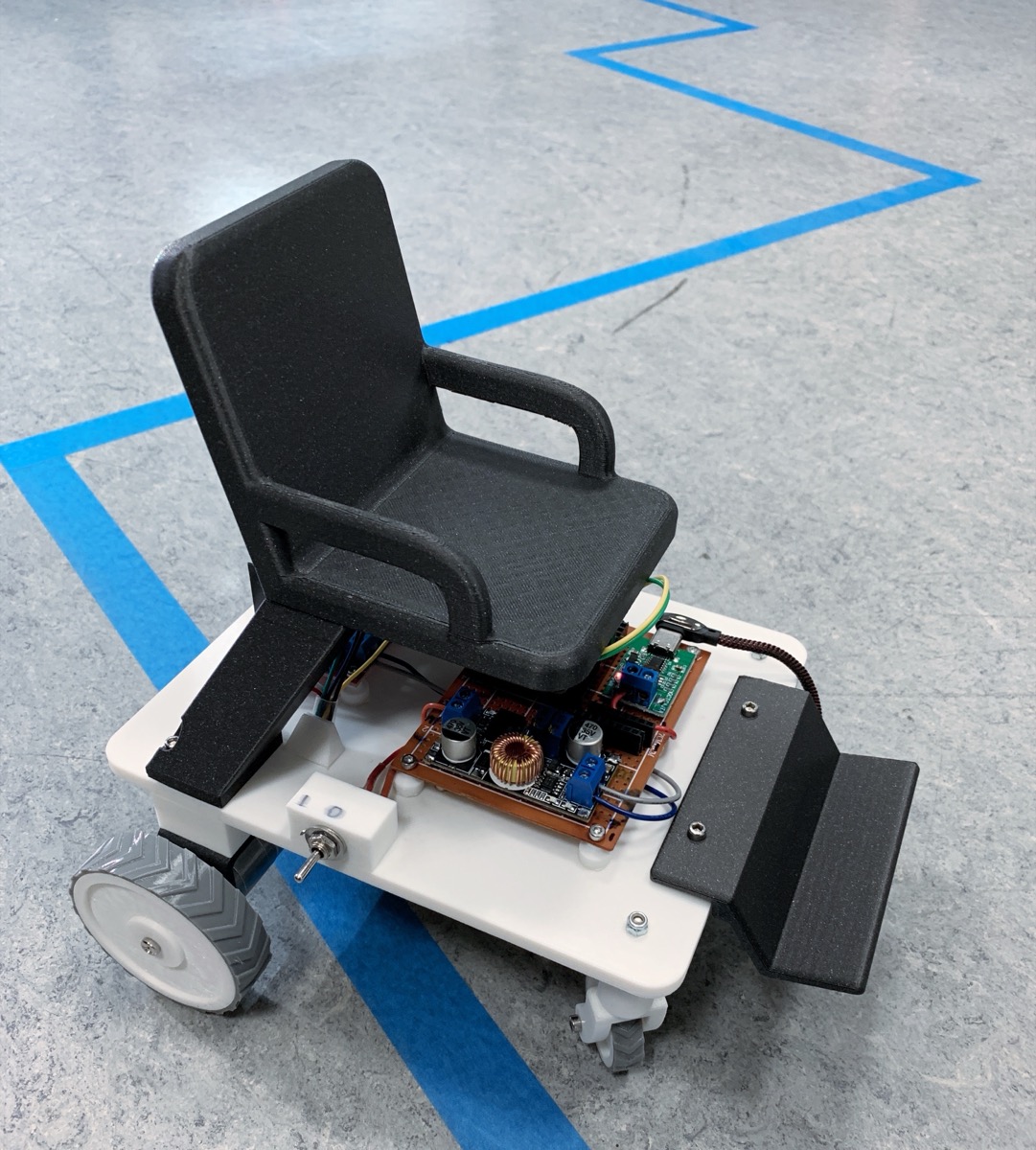
EEG-controlled robotic vehicle prototype

Figure 1. The EEG-controlled robotic vehicle built for motor imagery-based navigation. A user wearing a portable dry-electrode EEG headset generates motor imagery commands that are classified in real time and transmitted wirelessly to drive the vehicle along planned routes.

Abstract

The adoption of brain-computer interfaces (BCIs) has significantly increased in various application domains, particularly in controlling robotic systems through motor imagery. This work contributes in two primary ways:

  1. Validating the effectiveness of using a minimally invasive electroencephalography (EEG) device combined with machine learning techniques to control fundamental movements in a robotic setting.
  2. Demonstrating these findings practically through the construction of a robotic vehicle in which motor imagery tasks align directly with control commands.

Signals are acquired from a portable EEG device equipped with eight dry electrodes. We employ sliding-window segmentation, Common Spatial Pattern (CSP) feature extraction via a 12-band filter bank, and per-subject SVM and KNN classifiers. Experiments with five participants show that while four-class accuracy remains limited, binary classification achieves a promising average accuracy of approximately 61%, suggesting viable potential for dry-electrode EEG-based robot control.

Method

EEG signals are acquired from five participants using a portable Helmate device with eight dry electrodes positioned according to the international 10–20 system. The signal processing pipeline proceeds as follows: raw EEG is first band-pass filtered (0.5–48.5 Hz), then cleaned via ICA-based artifact removal. The continuous signal is segmented into 2.0-second windows with 0.5-second overlap.

Features are extracted using a 12-band Filter Bank (each with 4 Hz bandwidth) combined with Common Spatial Pattern (CSP), producing 96-dimensional feature vectors per window. Per-subject SVM and KNN classifiers are then trained for two settings: four-class motor imagery (left hand, right hand, both hands, feet) and two binary classification tasks (feet vs. both hands; right vs. left hand). The resulting predictions are transmitted wirelessly via Bluetooth to an ESP32 microcontroller on the robotic vehicle.

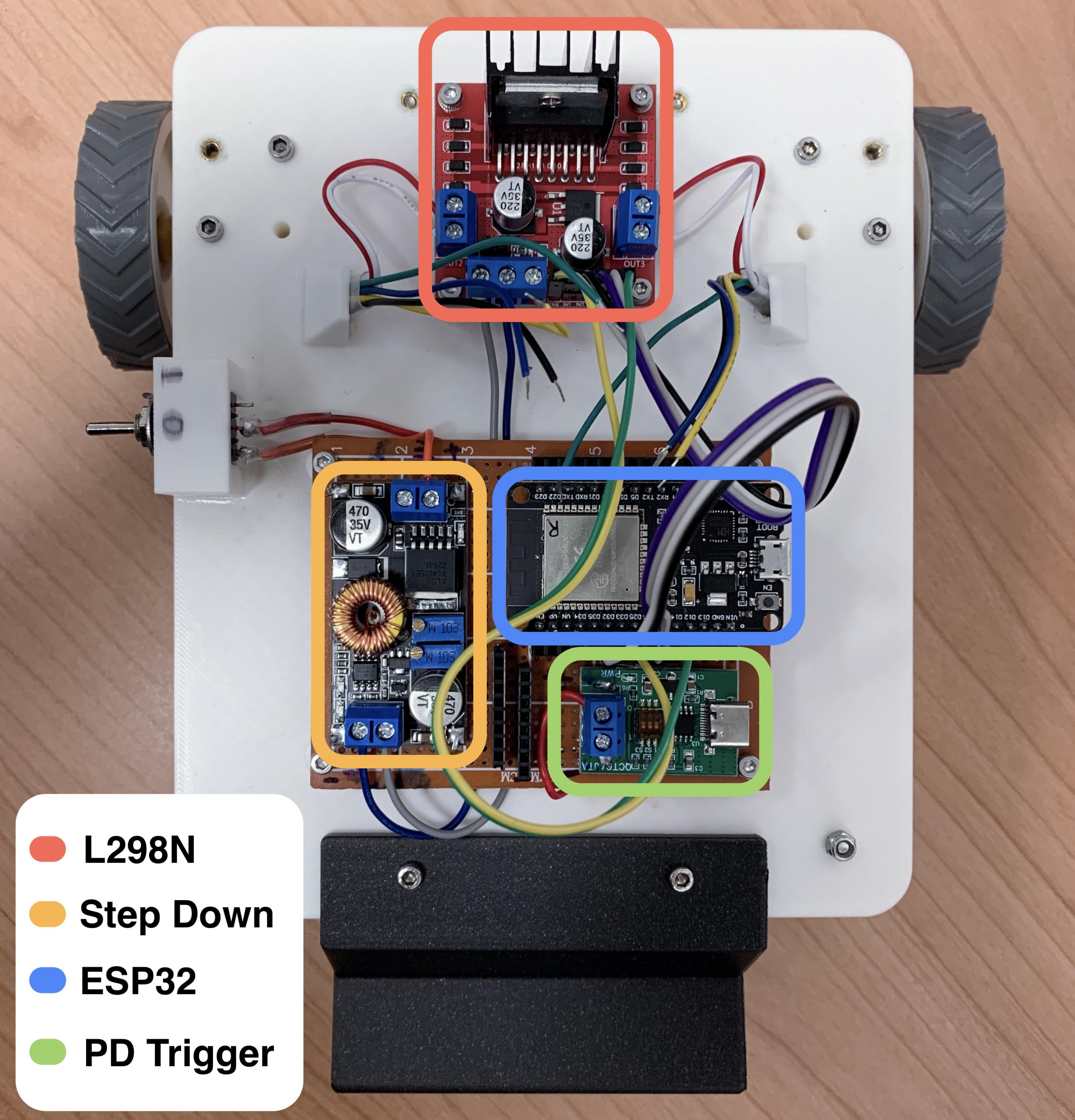
Top-down view of the robotic vehicle electronics

Figure 2. Top-down view of the robotic vehicle showing the L298N motor driver, step-down converter, ESP32 microcontroller, and PD trigger module.

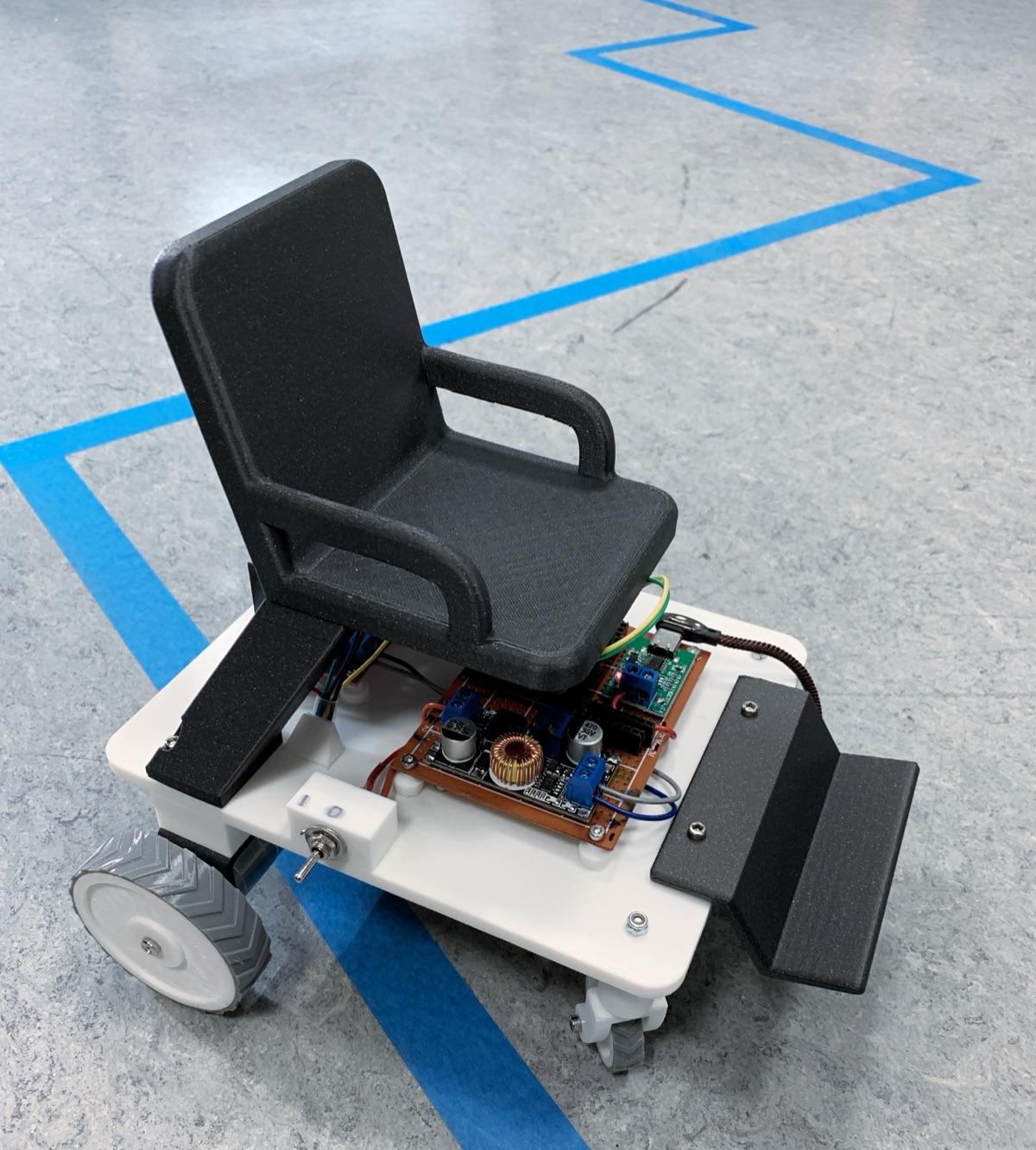
Assembled robotic vehicle

Figure 3. The assembled robotic vehicle used for motor imagery-based navigation experiments.

Results

Binary classification achieves the most promising results, demonstrating the practical viability of consumer-grade dry-electrode EEG for robotic control. All accuracy values are reported per participant with personalized models.

Per-Subject Classification Accuracy

Subject 4-Class KNN 4-Class SVM Feet/Hands KNN Feet/Hands SVM R/L Hand KNN R/L Hand SVM
S1 40.00% 40.00% 65.56% 65.56% 67.78% 55.56%
S2 38.95% 38.95% 61.11% 56.67% 52.22% 50.00%
S3 34.74% 26.36% 60.00% 63.33% 58.89% 50.00%
S4 33.78% 36.84% 56.67% 55.56% 57.78% 65.56%
S5 35.79% 37.86% 78.89% 66.66% 72.22% 57.78%
Avg ± Std 36.65 ±2.41 36.00 ±4.93 64.45 ±7.76 61.56 ±4.58 61.78 ±7.22 55.78 ±5.77

Table 1. Classification accuracy per subject and task. KNN consistently outperforms SVM across both binary settings. Subject 5 achieves the highest binary accuracy (78.89% on Feet vs. Hands), while four-class performance remains limited across all participants.

Vehicle Navigation Validation

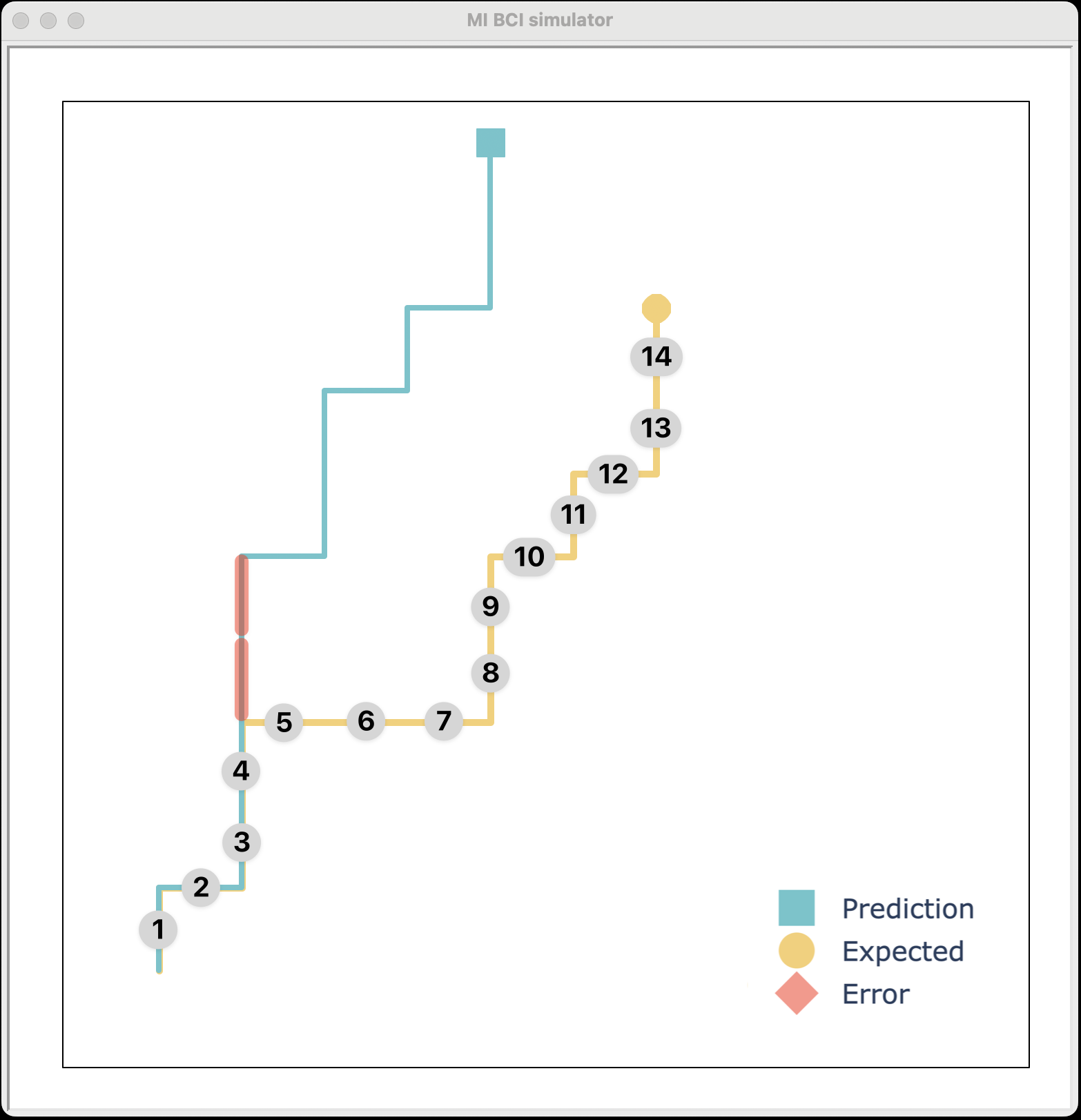
To validate real-world applicability, classified motor imagery commands are transmitted to the robotic vehicle, which executes corresponding movements along pre-defined routes. The simulator output below compares predicted routes against expected waypoints.
BCI simulator showing predicted vs expected vehicle route

Figure 4. BCI simulator output for one participant. Numbered waypoints show the expected route (orange) alongside predictions (cyan) and errors (red).

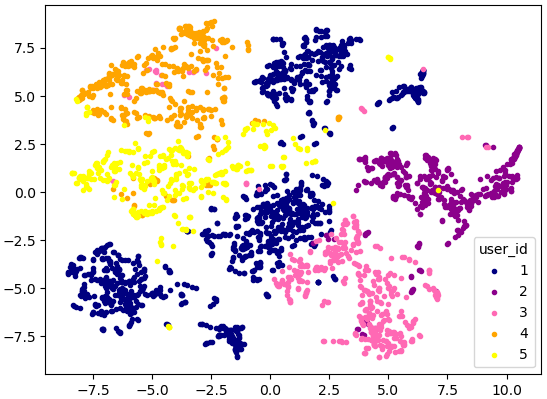
t-SNE scatter plot of CSP features colored by participant

Figure 5. t-SNE visualization of CSP-extracted EEG features, colored by participant (1–5). Clear per-subject clustering confirms significant inter-subject variability, justifying personalized classification models.

BibTeX

@inproceedings{amrani2024eeg,
  title     = {EEG Acquisition and Motor Imagery Classification
               for Robotic Control},
  author    = {Amrani, Hamza and Micucci, Daniela and Nalin, Marco
               and Napoletano, Paolo and Rizzi, Ilario},
  booktitle = {46th Annual International Conference of the IEEE
               Engineering in Medicine \& Biology Society (EMBC)},
  year      = {2024},
  organization = {IEEE}
}