TL;DR — We introduce a homogenization procedure that unifies 8 heterogeneous HAR datasets into a single framework, closing the performance gap from 24.3% to just 7.8% and enabling continual learning across diverse sensor configurations.
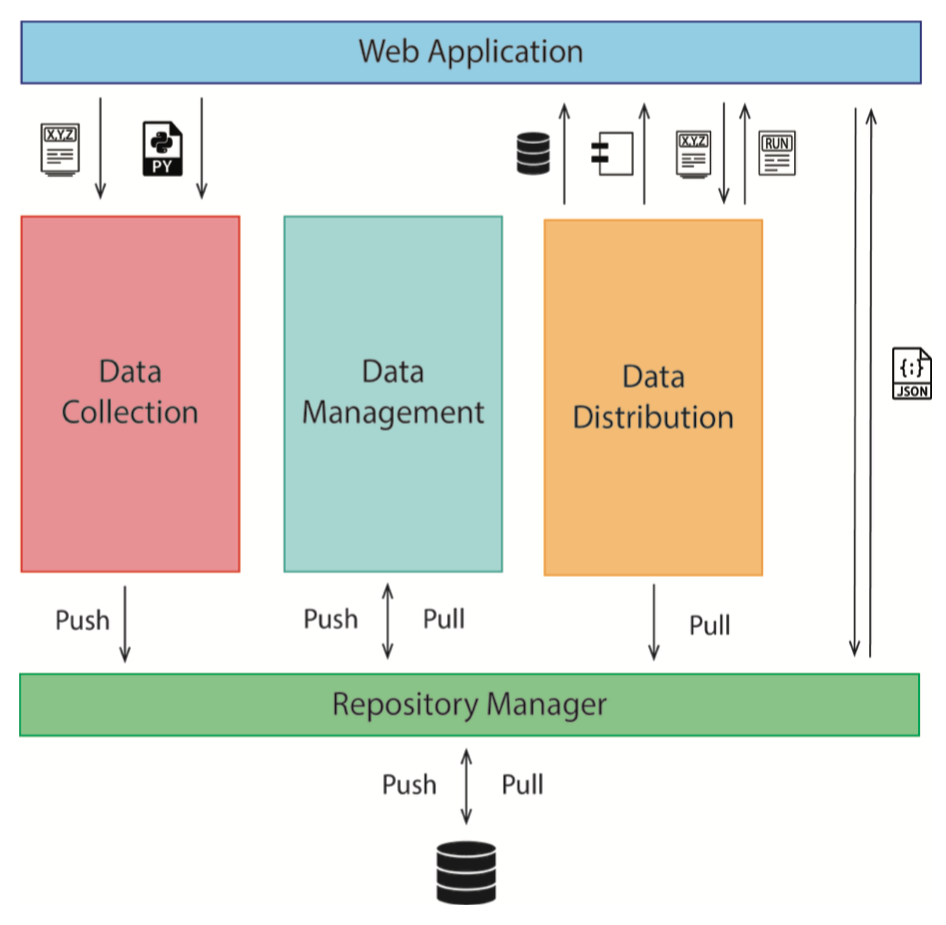
Figure 1. Architecture of the Continual Learning Platform (CLP). The system integrates heterogeneous HAR datasets through a homogenization pipeline that standardizes sampling frequencies, measurement units, gravity components, and activity labels — enabling unified training across eight publicly available benchmarks.
Human Activity Recognition (HAR) from wearable inertial sensors is a rapidly evolving field, yet machine learning models continue to struggle with two fundamental challenges: intra-class variability — the same activity performed differently across individuals — and inter-class similarity — distinct activities producing near-identical sensor patterns. Data-centric approaches can mitigate these issues, but they demand large-scale, multi-subject datasets whose acquisition is expensive and time-consuming. A natural solution is to pool existing public benchmarks — yet heterogeneity in sampling rates, units, coordinate frames, and label vocabularies makes naive merging counterproductive.
We address this challenge with three key contributions:
Evaluated on eight public benchmarks, our homogenization reduces the F1-score gap with single-dataset baselines from 24.3% to 7.8% on average — a relative improvement of 16.5 percentage points. Fine-tuning on a small per-user calibration set then closes the remaining gap entirely, achieving up to +8.5% over baseline accuracy and confirming the viability of data-centric strategies for robust, scalable HAR systems.
Our approach operates in two stages designed to transform a collection of incompatible sensor datasets into a unified, high-quality training resource.
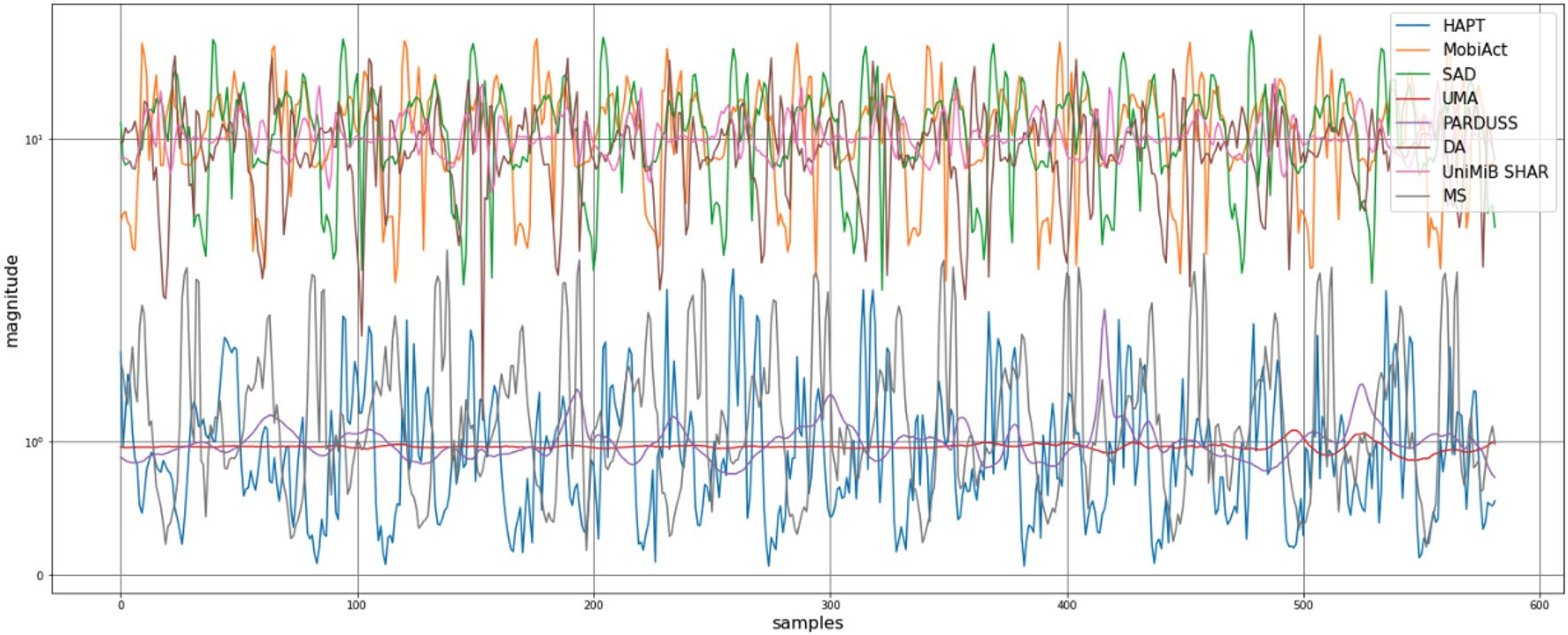
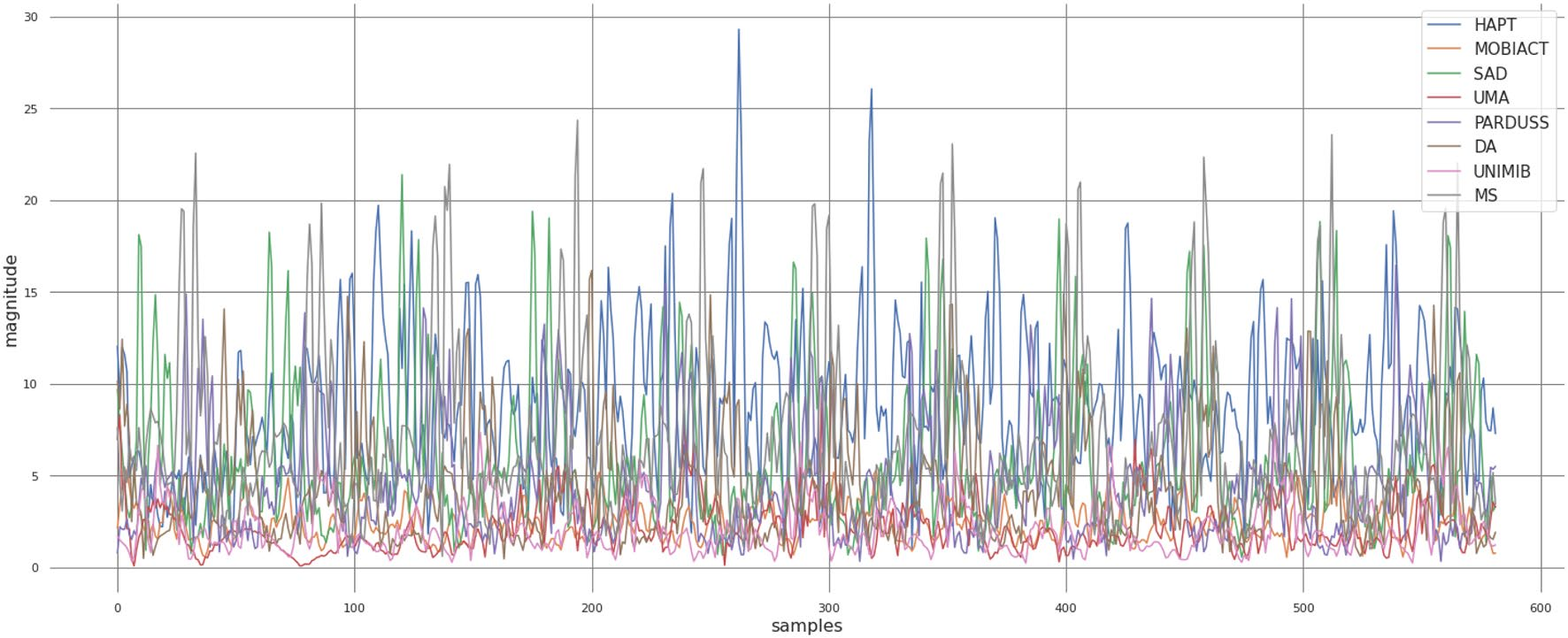
Stage 1 — Dataset Homogenization. We resolve four key sources of heterogeneity: (i) sampling frequency is unified to a common rate via resampling; (ii) measurement units and gravity components are standardized so that all accelerometer readings share the same physical scale; (iii) activity labels are aligned through a two-stage process combining Levenshtein-based syntactic matching with magnitude-based signal comparison graphs; and (iv) coordinate systems are reconciled by converting tri-axial signals to orientation-invariant magnitude representations. The entire pipeline is implemented within the Continual Learning Platform (CLP).
Stage 2 — Training and Adaptation. Two compact neural architectures — a Simplified CNN with four convolutional blocks (51.2K params) and an LSTM with two recurrent layers (42.1K params) — are trained on the merged dataset using a subject-independent protocol. Multiple overlapping windows provide data augmentation. For new-user adaptation, we freeze all layers except the final classifier and fine-tune on a small per-user calibration set, enabling continual personalization without retraining from scratch.
Figure 2a. Raw accelerometer signals from multiple HAR datasets before homogenization. Sampling rates, amplitude scales, and gravity components vary widely across sources.
Figure 2b. The same signals after homogenization. All datasets now share a consistent sampling rate, scale, and orientation — enabling effective cross-dataset training.
Figure 3. System schema. The CLP coordinates three microservices — Data Collection, Data Management, and Data Distribution — through a central Repository Manager that stores and homogenizes data from eight heterogeneous HAR datasets before feeding them to the neural architectures.
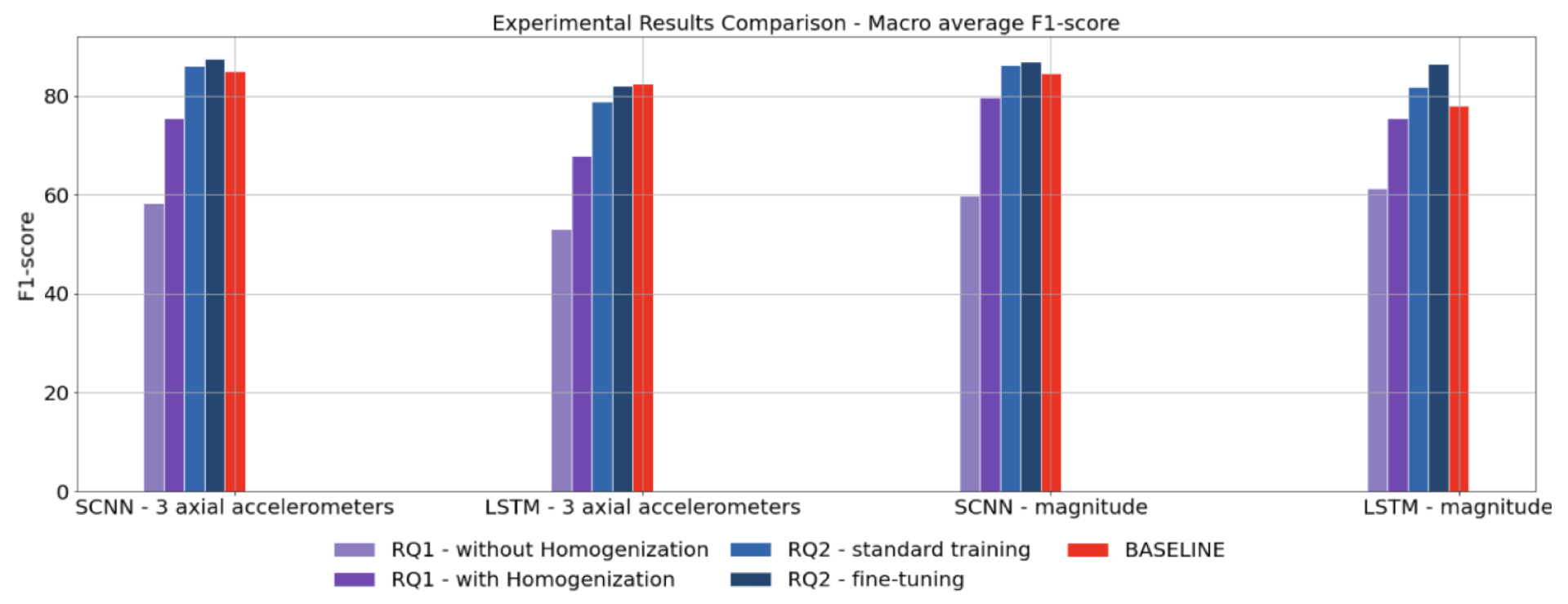
We evaluate four experimental configurations across two input types (tri-axial accelerometer, 3ACC; magnitude, MAGN) and two architectures (S-CNN, LSTM). Baseline trains on each dataset individually; Non-Homogenized and Homogenized merge all datasets without/with our procedure; Fine-Tuning adapts the homogenized model to individual users.
| Configuration | Baseline | Non-Homogenized | Homogenized | Fine-Tuning |
|---|---|---|---|---|
| 3ACC — S-CNN | 85.06 | 58.35 (-26.71) | 75.47 (-9.59) | 87.61 (+2.55) |
| 3ACC — LSTM | 82.45 | 53.09 (-29.36) | 67.88 (-14.57) | 81.96 (-0.49) |
| MAGN — S-CNN | 84.55 | 59.92 (-24.63) | 79.76 (-4.79) | 87.00 (+2.45) |
| MAGN — LSTM | 78.09 | 61.27 (-16.82) | 75.55 (-2.54) | 86.57 (+8.48) |
Table 1. Comparison across all configurations. Homogenization consistently recovers most of the performance lost from naive merging. Fine-tuning surpasses single-dataset baselines in three of four settings, with MAGN-LSTM achieving the largest gain (+8.48% over baseline).
Without homogenization, naive dataset merging causes an average 24.3% F1-score drop compared to single-dataset baselines — confirming that heterogeneity is a major bottleneck. Our homogenization procedure reduces this gap to 7.8% on average, a relative improvement of 16.5 percentage points. Fine-tuning on a small per-user calibration set then closes the remaining gap entirely: in three of four configurations, the fine-tuned model exceeds the single-dataset baseline, with gains of up to +2.55% (3ACC-SCNN) and +8.48% (MAGN-LSTM). These results confirm that diverse, heterogeneous data sources — when properly unified and adapted — can yield stronger HAR models than any single dataset alone.
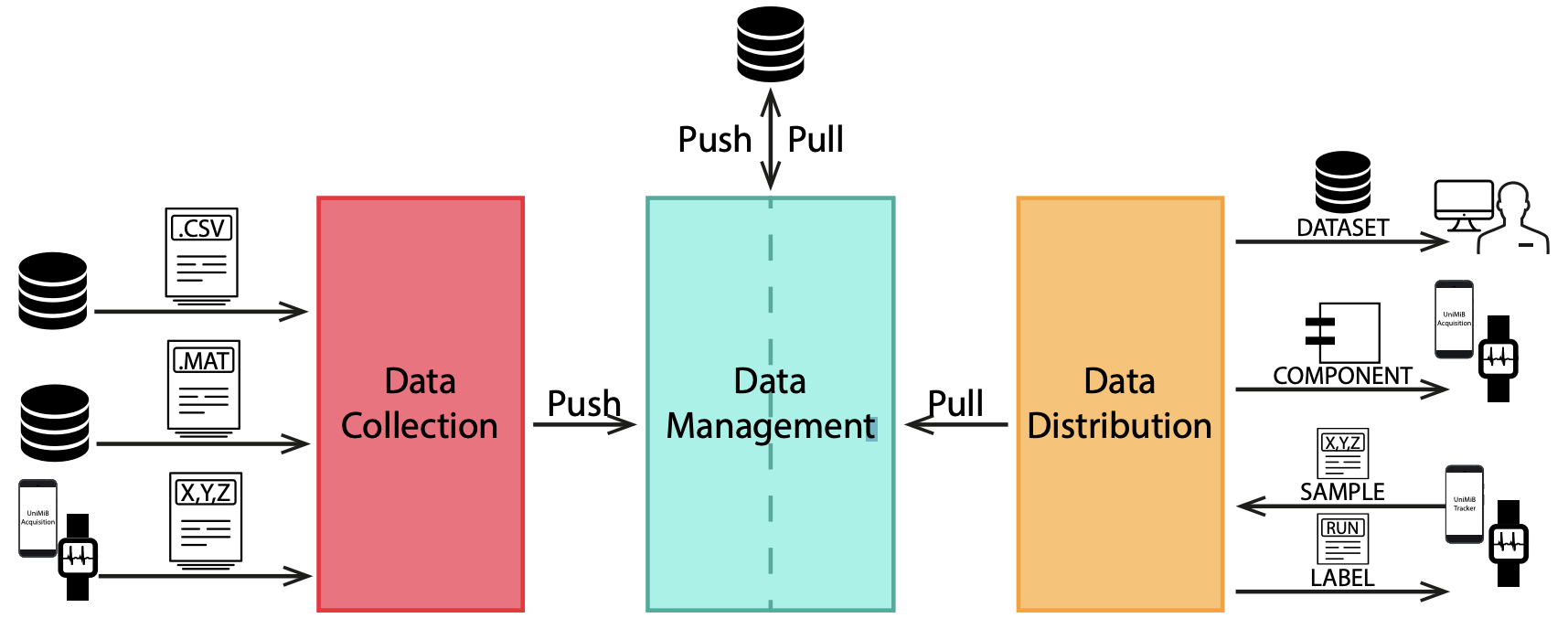
Figure 4. Macro-average F1-scores across all configurations and experimental conditions. Homogenization consistently recovers performance toward single-dataset baselines, and fine-tuning matches or exceeds them in the majority of settings.
@article{amrani2025leveraging,
title = {Leveraging Dataset Integration and Continual Learning
for Human Activity Recognition},
author = {Amrani, Hamza and Micucci, Daniela and Mobilio, Marco and Napoletano, Paolo},
journal = {International Journal of Machine Learning and Cybernetics},
year = {2025}
}